Tree Removal Services and the Risks of DIY Work
A tree can make a property feel settled and alive. It throws shade where you need it, frames a house, softens wind, and gives a yard a sense of scale that shrubs and fencing never quite achieve. That same tree can also become the most technically demanding feature on the property the moment it starts to fail, crowd a structure, or break apart after a storm.
That is where the gap between routine yard work and professional tree care becomes very clear.
People often lump all tree work into the same category. Mowing, edging, hedge trimming, branch cutting, stump grinding, tree removal, storm cleanup, it all gets treated as outdoor labor. In practice, the differences matter. Tree service work commonly includes pruning, removal, maintenance, and storm-damage response for homes and commercial sites. Some of those tasks look simple from the ground. They are not simple once weight, height, decay, structure, and the direction of failure enter the picture.
The temptation to handle it yourself usually starts with a reasonable thought. The branch looks reachable. The trunk does not seem that large. The tree has been leaning for months and has not fallen yet. The stump is ugly and in the way, so maybe it can be taken out over the weekend. On paper, that sounds manageable. In the field, even a modest job can change fast.
The strongest argument for professional Tree Removal Services is not convenience. It is judgment. The work itself matters, but the decision-making before the first cut matters just as much.
Why DIY tree work goes wrong
Large-tree pruning and removal are widely recognized as dangerous work that should be done only by people who are trained and equipped to work safely in trees. That point gets repeated so often because it remains true no matter how many home videos make removal look routine.
The danger is not limited to the obvious image of a whole tree crashing down. Trouble often begins much earlier, when someone misreads weight distribution, assumes a limb is sound when it is compromised, or starts cutting without Look at this website a controlled plan for where the wood will move. A branch can twist. A stem can split. Material can hang up in the crown and then drop without warning. If the tree is near a roof, fence, drive, or neighboring property, the margin for error gets thin very quickly.
There is also a common misunderstanding about size. Homeowners sometimes assume the only truly hazardous work involves very tall trees. Height certainly increases complexity, but smaller trees can still create serious problems if they are decayed, tightly surrounded by targets, or poorly structured. A short, broad ornamental tree over a patio may be a more delicate removal than a taller specimen standing in open ground.
Another problem with DIY work is that people often focus on the visible part of the tree and miss the context around it. Professional arborists do not look only at the branch someone wants removed. They evaluate the whole tree, the likely load paths, defects they can see from the ground, and what sits within striking distance if something moves unexpectedly. That broader view is one reason a Certified Arborist Consultation has value even before removal is discussed.
Tree removal is often the last step, not the first
One of the more useful things a trained arborist brings to a property is restraint.
Many owners call a company assuming the tree has to come down. Sometimes that is the correct answer. Sometimes it is not. Tree risk guidance in arboriculture treats risk assessment as a systematic process. The goal is to identify, analyze, and evaluate risk, then recommend measures that bring risk to an acceptable level. That does not automatically mean removal.
This point is worth slowing down for. There is no completely safe tree. Some level of risk exists with any tree, particularly mature trees in occupied spaces. The professional question is not whether risk can be erased. It is whether risk can be reduced appropriately without unnecessary intervention.
That is where services like Tree Pruning & Crown Shaping, Tree Cable and Bracing, and targeted maintenance come into the conversation. A tree with structural issues may need support rather than removal. A canopy with poor clearance or overextended limbs may respond well to careful pruning. A crown that has grown in a way that increases stress on certain unions may benefit from corrective work. A tree with storm damage may need selective cuts and monitoring, not full dismantling.
This is a major blind spot in DIY decision-making. Homeowners who go straight to cutting often choose the biggest possible intervention because it feels decisive. Professionals are trained to consider a range of treatments.
What professional assessment actually adds
A Certified Arborist is trained in the art and science of tree care, must pass a comprehensive exam, continue education to maintain the credential, and work under a Code of Ethics. Those details matter because tree work combines biology, mechanics, and field execution. You need someone who can read the tree and the site, not just someone willing to cut wood.
When I have watched experienced crews size up a problem tree, what stands out is how much of the job is solved before the cutting begins. They are evaluating defects, structure, access, likely failure points, and how each piece will be managed as it comes free. Even straightforward Dangerous Tree Assessment and Removal starts with questions a do-it-yourselfer may never think to ask. Is the defect active or historic? Is the crown overloaded? Is pruning enough to reduce the hazard? Would structural support help? Is the target area permanent, like a house, or occasional, like a side yard?
This is also why emergency work is so difficult for property owners to judge on their own. After wind or heavy weather, a tree may still be standing but no longer stable. Broken tops, split stems, and suspended limbs can create unpredictable conditions. Emergency Tree Services exist for exactly these scenarios, where urgency and technical control have to coexist.
A useful consultation typically clarifies three things at once. It explains the condition of the tree, the level and type of risk, and the realistic treatment options. That can save money, but more importantly, it can prevent the wrong work from being done.
Pruning mistakes are not harmless
DIY conversations often treat pruning as the safe alternative to removal, as though cutting a few branches is automatically low risk. Sometimes it is lower risk. That does not make it low skill.
Proper pruning is not random thinning. Arboriculture guidance includes crown reduction, directional pruning, crown raising, and proper branch removal or reduction cuts. It also warns against practices like topping and leaving stub cuts. Those improper techniques can change the tree’s structure in ways that create future problems rather than solving current ones.
That matters for both safety and tree health. A poorly cut limb does not just look rough. It can alter how the tree responds, where new growth forms, and how loads are carried in the canopy. Topping, in particular, is often chosen by owners trying to reduce height quickly. It feels practical because it produces an immediate visual result. In reality, it is a blunt response to a structural problem and often leads to a weaker, less stable crown over time.
Tree Pruning & Crown Shaping, when done well, is measured work. The cuts are selected with a purpose. The objective may be to reduce end weight, improve spacing, raise clearance, or guide growth away from a conflict. The difference between that and casual branch removal is enormous, even if both involve a saw.
The hidden complexity of controlled lowering
One of the least appreciated parts of tree work is what happens after a limb is cut free.
In open space, a piece might be able to drop cleanly. Around buildings, fences, vehicles, landscaping, or power-adjacent areas, that is rarely acceptable. Professional crews use rigging techniques and controlled lowering to manage cut material. That means each piece is not only severed but also guided, restrained, and brought down in a way that limits shock, swing, and collateral damage.
This is where many DIY plans fall apart. The branch someone intends to “just take off” is not the difficult part. The difficult part is controlling the branch once gravity takes over. Wood does not always behave like people expect. It can rotate, bounce, bind, or strip bark on the way down. A piece that misses the roof can still smash a gutter, punch through a fence, or strike another limb and ricochet.
Professionals are trained for this kind of controlled work. That training does not make the task risk-free, but it reduces guesswork. A do-it-yourself approach often replaces a planned lowering system with hope.
Stumps are not an afterthought
After the tree is down, many owners feel the hard part is over. Not always.
Stump Removal & Grinding gets treated as cleanup, but it has its own practical and aesthetic consequences. A stump left in place can interfere with use of the space, change grading and planting plans, and remain a visible reminder of the tree long after the crown is gone. Grinding or removal may be part of the original scope for that reason.
The do-it-yourself version of stump work tends to underestimate the effort involved. The stump itself is only part of the issue. Root flare, surrounding soil, access, and the intended future use of the area all affect what makes sense. If the goal is simply to stop looking at the stump, one solution may be enough. If the goal is replanting, hardscaping, or reclaiming a lawn area, the approach may differ.
This is another place where a quick professional conversation can save frustration. Removal, grinding, and site restoration are related, but they are not identical outcomes.
When emergency work changes the rules
Storm-damaged trees create a particular kind of false confidence. People see a branch already broken and assume the danger has passed because the damage is visible. In reality, visible damage often signals hidden instability.
Emergency Tree Services are not just fast removals. They are specialized responses to trees that may be partially failed, hanging, split, or loaded in ways that normal maintenance crews would rather not encounter casually. The work is often time-sensitive because the tree threatens a house, driveway, sidewalk, or occupied area. At the same time, the urgency makes patience even more important.
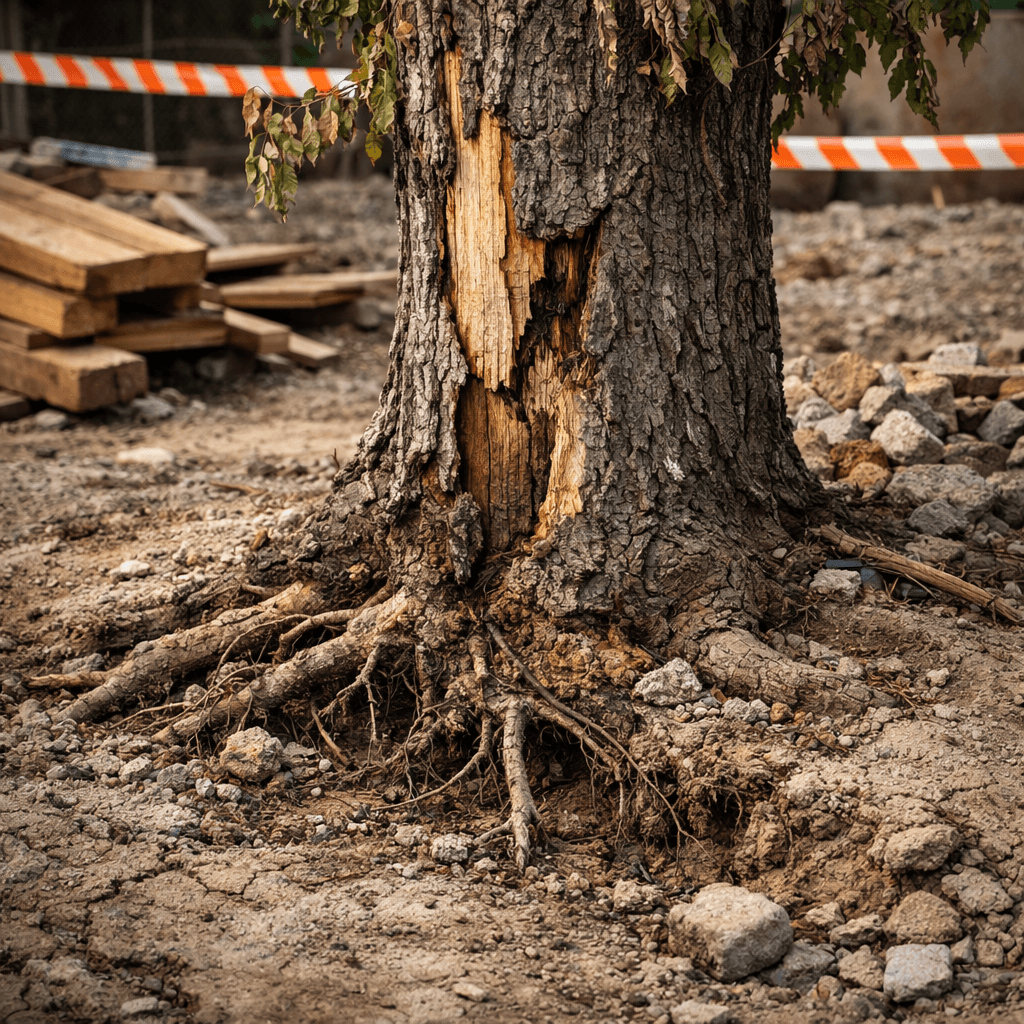
A homeowner standing under a cracked leader after a storm is usually focused on the immediate obstruction. A trained crew is thinking about whether the remaining wood is under tension, whether another section is likely to fail next, and how to restore access without triggering further movement.
If a tree has recently shifted, broken, or dropped major limbs, that is generally not the time for improvised cutting. It is the time for assessment and stabilization.
Fire risk, spacing, and site judgment
In some landscapes, tree work is not only about property maintenance. It is also about fuel management and defensible space. FireSmart Tree Services fit into this category. The point is not to strip a property bare. It is to make deliberate decisions about pruning, spacing, and removal where wildfire exposure is a concern.
This is another area where overreaction and underreaction are both common. Some owners remove too much and lose the environmental and visual benefits that made the landscape valuable in the first place. Others make cosmetic cuts that do little to address the real issue. Sound guidance helps distinguish between a tree that should be retained with maintenance and one that creates an unacceptable hazard because of placement, condition, or fuel continuity.
That same judgment often overlaps with standard risk management. A tree that is poorly maintained, structurally weak, and positioned close to structures may already warrant intervention before fire behavior is considered.
Cable and bracing are not shortcuts
Tree Cable and Bracing sometimes get misunderstood as ways to avoid difficult decisions. They are better thought of as structural support tools used in selected situations.
Support systems can reduce the likelihood of failure in trees with certain structural concerns, but they are not universal fixes and they do not make a weak tree “safe” in an absolute sense. Remember the broader principle, no tree is completely safe. Risk can be reduced, managed, and monitored, but not erased.
This is why support work belongs inside a larger assessment rather than as a stand-alone request from a property owner. A cable or brace should respond to an identified condition and a clear management goal. Used appropriately, it may help preserve a valued tree that would otherwise be at greater risk of failure. Used casually, it can create false confidence.
The difference lies in diagnosis.
Signs that a job has moved beyond DIY
There is no prize for handling tree work alone when the conditions are telling you otherwise. A property owner does not need perfect technical language to know when the work has crossed into professional territory. A few situations should immediately slow the impulse to grab tools and start cutting:
- The tree is large, near structures, or overhangs spaces people use regularly.
- The tree shows obvious defects such as splitting, heavy lean, broken tops, or major dead sections.
- Storm damage has left limbs hanging or the crown partially suspended.
- The job requires climbing, rigging, or controlled lowering of sections.
- You are unsure whether pruning, support, or full removal is the right answer.
That last point is underrated. Uncertainty itself is a signal. When you cannot confidently define the problem, you should not be prescribing the treatment.
What a professional visit often helps clarify
Many people delay calling because they assume the first conversation locks them into a major expense or a full removal. Often, it simply creates a clearer set of options. A site visit may lead to one or more of the following outcomes:
- A recommendation for removal because the risk is too high or the defects too significant.
- A pruning plan focused on crown reduction, directional pruning, or clearance.
- Structural support through Tree Cable and Bracing where appropriate.
- A plan for Stump Removal & Grinding after removal, based on future use of the site.
- Advice on Emergency Tree Services or FireSmart Tree Services if the situation or location calls for it.
That range is exactly why Certified Arborist Consultation is valuable. The best outcome is not always the biggest job. It is the right job.
Cost is real, but so is the cost of being wrong
DIY tree work usually starts as a cost-saving measure. That instinct is understandable. Professional tree crews bring labor, equipment, training, and often specialized planning to the site. Those services are not casual expenses.
But cost should be weighed against consequences, not just against the price of a saw rental or a free weekend. If pruning is done incorrectly, the tree may need corrective work later. If a removal goes badly, the property damage can easily exceed the original service cost. If a dangerous tree is misjudged and left untreated, the delay may turn a manageable project into an emergency response.
There is also the quieter cost of lost options. A tree that might have been retained through proper pruning or support can be ruined by poor cuts. A stump that could have been addressed efficiently as part of the original project becomes a separate headache months later. A property owner who acts too fast or too late often pays twice, once for the mistake and once for the fix.
Professional tree care is not just about doing hard work for the client. It is about reducing expensive uncertainty.
Good tree care is careful, not dramatic
Tree work attracts dramatic images. Massive removals, storm takedowns, giant limbs being lowered over roofs. Those jobs are real, but most good arboriculture is quieter than that. It is careful assessment, accurate pruning, thoughtful mitigation, and knowing when intervention should be light rather than aggressive.
That professional discipline matters because trees are living structures, not just obstacles made of wood. Their condition changes over time. Their risk profile depends on the site. Their value is not limited to appearance, and their hazards are not always obvious from the lawn chair view.
When owners call for Tree Removal Services, they are often really asking a broader question: Is this tree still manageable, and if so, how? Sometimes the answer is removal. Sometimes it is Dangerous Tree Assessment and Removal because waiting no longer makes sense. Sometimes it is Tree Pruning & Crown Shaping, Tree Cable and Bracing, or a FireSmart Tree Services plan that preserves the tree while lowering risk.
The common thread is professional judgment.
A homeowner can do many things well on a property. Painting a fence, reseeding a lawn, repairing irrigation, reshaping a garden bed, all fair game for a capable weekend. Tree work becomes different when the biology of the tree intersects with gravity, structural defects, and occupied space. At that point, the smart move is not bravado. It is knowing where your limits are, bringing in trained help, and letting the job be approached with the care it demands.
Name: Ace Tree Services Ltd.
Address: 4656 Wallace Hill Road, Kelowna, BC
Phone: 250-212-9593
Website: https://acetree.ca/
Hours:
Monday: 7:00 AM–5:00 PM
Tuesday: 7:00 AM–5:00 PM
Wednesday: 7:00 AM–5:00 PM
Thursday: 7:00 AM–5:00 PM
Friday: 7:00 AM–5:00 PM
Saturday: 7:00 AM–5:00 PM
Sunday: Closed
Emergency tree services: 24/7 emergency service is listed.
Open-location code / Plus code: RHF8+8G Kelowna, British Columbia, Canada
Map/listing URL: https://www.google.com/maps/place/Ace+Tree+Services+Ltd./@49.8232606,-119.4337283,563m/data=!3m1!1e3!4m6!3m5!1s0x537d8b1d074815c5:0x450b88afa7a41435!8m2!3d49.8232606!4d-119.4337283!16s%2Fg%2F11ydkpnh22
Embed iframe:
Socials: https://www.facebook.com/people/Ace-Tree-Services/61585901931447/
https://m.yelp.com/biz/ace-tree-services-kelowna
Ace Tree Services Ltd. provides professional tree service for residential, commercial, and municipal customers in Kelowna and across the Okanagan Valley.
The company’s listed services include tree removal, stump removal and grinding, tree pruning and crown shaping, emergency tree services, certified arborist consultation, dangerous tree assessment, tree cable and bracing, and wildfire mitigation.
Ace Tree Services works with homeowners, businesses, property managers, and public-sector clients that need safe, practical tree care in the Kelowna area.
The official site highlights ISA-certified arborists, insurance, and experience handling both routine and complex tree service situations.
Customers can contact Ace Tree Services for tree care planning, hazard concerns, emergency tree cleanup, pruning needs, stump grinding, or advice about trees near homes, fences, driveways, and landscaping.
Ace Tree Services lists regular work hours from 7:00 AM to 5:00 PM Monday through Friday, with 24/7 emergency tree service available for urgent situations.
For tree service in Kelowna, call 250-212-9593 or visit https://acetree.ca/
The public map listing places Ace Tree Services Ltd. in Kelowna and can help customers find directions to the Wallace Hill Road area.
Popular Questions About Ace Tree Services Ltd.
What services does Ace Tree Services Ltd. provide?
Ace Tree Services Ltd. provides tree removal, stump removal and grinding, tree pruning and crown shaping, emergency tree services, certified arborist consultation, dangerous tree assessment and removal, tree cable and bracing, and wildfire mitigation.
Where is Ace Tree Services Ltd. located?
The official website lists Ace Tree Services Ltd. at 4656 Wallace Hill Road, Kelowna, BC.
What areas does Ace Tree Services Ltd. serve?
The official website describes Ace Tree Services as located in Kelowna and servicing the Okanagan.
What phone number should customers call?
Customers can call Ace Tree Services Ltd. at 250-212-9593.
What are Ace Tree Services Ltd.’s regular hours?
The official website lists work hours as 7:00 AM to 5:00 PM, Monday through Friday. Saturday and Sunday regular hours are not listed and should be confirmed directly.
Does Ace Tree Services Ltd. offer emergency tree service?
Yes. The official website lists 24/7 emergency services for urgent tree situations, including emergency tree removal, dangerous tree assessment, stabilization, and limb or branch cleanup.
Does Ace Tree Services Ltd. have certified arborists?
Yes. The official website states that Ace Tree Services has ISA-certified arborists.
Can Ace Tree Services Ltd. help with wildfire mitigation?
Yes. Wildfire mitigation is listed as one of the company’s tree services.
How do I contact Ace Tree Services Ltd.?
Call 250-212-9593 or visit https://acetree.ca/.
Landmarks Near Kelowna, BC
Wallace Hill Road: A local Kelowna road near the address listed for Ace Tree Services Ltd.
Okanagan Lake: A major Kelowna landmark near residential, commercial, and waterfront properties that may need tree pruning, removal, or hazard assessment.
Downtown Kelowna: A central area with homes, offices, rental properties, restaurants, and commercial sites that may need professional tree care.
Mission / Lower Mission: A well-known Kelowna area with mature landscaping, residential properties, and lake-adjacent homes.
South East Kelowna: A rural and residential area with larger properties, orchards, and tree-care needs that can include pruning, removals, and wildfire mitigation.
Crawford: A residential area near the southeast side of Kelowna where homeowners may need tree trimming, hazard assessment, and stump grinding.
Kettle Valley: A hillside residential neighborhood where tree condition, slope, wind exposure, and defensible-space planning can matter for property owners.
Myra-Bellevue Provincial Park: A major outdoor landmark near southeast Kelowna and a useful point of orientation for nearby properties.
Gallagher’s Canyon: A residential and golf community near southeast Kelowna where tree maintenance and wildfire-conscious vegetation management can be practical concerns.
Orchard Park Shopping Centre: A major central Kelowna retail landmark and reference point for customers traveling across the city.
Highway 97: A major Kelowna corridor connecting neighborhoods, commercial properties, and service routes throughout the region.
Kelowna City Park: A recognizable central landmark near downtown neighborhoods and lakefront properties.
Glenmore: A Kelowna neighborhood with residential and commercial properties that may need pruning, storm cleanup, and general tree care.
Rutland: A large residential and commercial area where customers may need tree removal, pruning, stump grinding, or arborist consultation.
Black Mountain: A hillside community where slope, wind, wildfire exposure, and access can influence tree service planning.
For tree service near these Kelowna landmarks, contact Ace Tree Services Ltd. at 250-212-9593 or visit https://acetree.ca/